
News and Events
The robotics industry is constantly changing and evolving. New robotics technologies and developments in automation are quickly creating exciting career opportunities at every education level – from micro-credentials to PhDs. Here is where you can learn more about robotics careers in manufacturing and how these new technologies are benefiting workers
NEWS
Manufacturing Processes That Use Automation and Robots
By John Zappa | June 23, 2021As we delve further into Industry 4.0, the presence of robotics and automation is steadily increasing in various manufacturing processes. It’s not uncommon to see both industrial robots and collaborative robots present on the manufacturing floor.
It wouldn’t be a stretch to say that robots are essential to manufacturing projects of all scopes and sizes at this point, and their presence will only continue to grow as we move into the future of the industry.
But what exactly is it that these robots are doing that makes them so important?
The Benefits of Robots in Manufacturing
There are several key areas where robots are beneficial to manufacturing, the most prominent is their ability to boost efficiency.
Robots never sleep, especially not large industrial robots, so they can be productive on a 24/7 basis except when shut down for maintenance. That means they’re constantly able to work and produce output without any need for breaks.
Smaller collaborative robots, or cobots, are adaptable and easy to repurpose to fit new tasks. Their tools are usually interchangeable and they’re easy to program and control. That means they are ideal for manufacturing automation across a variety of areas on the manufacturing floor.
In terms of safety, robots in manufacturing are able to handle materials and work in conditions that people simply aren’t suited for. As such, they perform the most dangerous tasks while keeping workers out of harm's way.
Manufacturing Processes That Use Robotics and Automation
Robots can handle a variety of tasks in the manufacturing process, but they can be summarized into 5 categories.
Material Handling
As mentioned above, robots in manufacturing can handle hazardous materials. When a product requires unwavering steadiness and presents a risk of danger or contamination if mishandled, robots are the perfect choice for the job. They never grow tired or make mistakes and they don’t have to worry about contamination or harm. Robots are great at handling everything from heavy crates to blood samples with great efficiency.
Welding
Welding is a task that requires precision and exposes the worker to dangerous conditions due to the extreme heat and pressure involved in the process. This makes it a perfect job for robots and manufacturing automation, and they are increasingly being used in the place of workers for welding tasks.
Assembly
Assembling products can be a repetitive and boring job that leads to moments of inattention and lapses of judgment. That’s why it’s perfect for manufacturing automation. Robots don’t get bored; they thrive in repetitive tasks, and they never stop paying attention. They’re the perfect assembly workers!
Dispensing
Another repetitive task that can be handled by robots in manufacturing is the dispensing of glue, paint, or sprays to a surface as part of a production line automation. Robots can be placed at various strategic points along the product’s path of assembly to dispense materials as it passes by.
Processing
Depending on the complexity of the processing task, robots can be used for certain types of processing that occur on various production lines, such as carving, polishing, or sawing.
Why These Manufacturing Tasks Create Career Paths
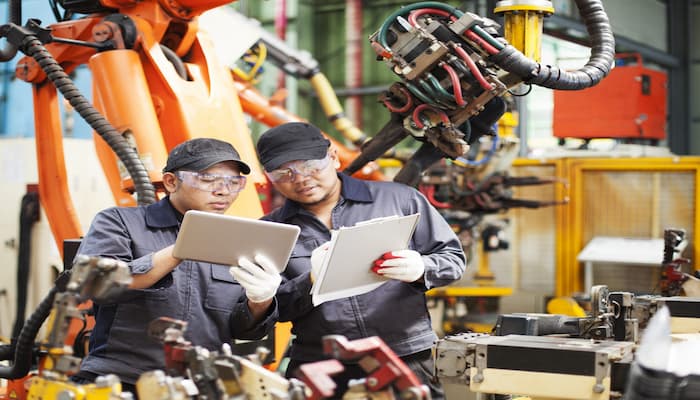
Factories rely on robots for a lot of the heavy lifting, though the people behind them are what really keep things moving. Take a welding robot; it's only as good as the program guiding it. A material handling system needs someone to set it up, check it, and keep it running. Assembly equipment needs an operator who can catch small problems before they snowball into a shutdown. Anyone who has spent time around machines knows how one bad sensor can wipe out half a shift.
That is exactly where robotics career training meets real factory work. A lot of workers step in at the ground floor. They run equipment. They inspect parts. They read work instructions and start to notice patterns in how automated systems behave. Skills in troubleshooting, programming, maintenance, integration, and quality control develop over time, shift by shift.
Manufacturing automation is one of the more practical ways to break into an industry that keeps reinventing itself. Some folks come in through a technical program. Others start on the production floor first. Either way, the door to more advanced robotics work tends to open as experience adds up.
Workers Are Essential to Robots in Manufacturing
While it may seem like robots are replacing workers in manufacturing, the reality is quite the opposite. Robots in manufacturing can’t operate without people to program them, maintain them, design them, troubleshoot them, etc. If anything, the use of robots in the industry is creating a greater demand for skilled workers than ever before.
That’s where the ARM Institute and RoboticsCareer.org come in. We’ve provided a convenient way for those who are interested in pursuing a career in robotics with thousands of educational programs and organizations around the country. Skilled robotics workers are in demand, and whether you’re looking to become a robotics technician, a robotics specialist, or a robotics integrator, it’s our mission to help you get started on your path.
RoboticsCareer.org helps you explore training and career paths for roles that support automated systems, production equipment, and robotics on the manufacturing floor. Create a profile and begin your search today and discover an exciting future in robotics!
About The Author
John Zappa
John Zappa is the Director of Product Management at the Advanced Robotics for Manufacturing (ARM) Institute. In this role, he is responsible for developing and promoting services that help the organization fulfill its mission to train and empower the manufacturing workforce for careers in robotics.
An industry expert on lifelong learning, John has spoken at numerous industry conferences including Chief Learning Officer Symposium, Society of Human Resource Management, and The Conference Board, and has co-authored articles on corporate tuition assistance programs and talent management.
During his career, he helped to found and serve as CEO of EdLink, LLC a leading provider of tuition assistance management services. Under John’s leadership, EdLink grew to manage over $220 million in education funding. The firm was acquired by the Fortune 500 firm Bright Horizons Family Solutions (BFAM). A pioneer in the field, he created the industry’s first education network to address the rising cost of education for adult learners. It is now considered the industry standard.
With thirty years’ experience, John has built and led marketing, operations, and product management teams in software-based companies across multiple industries. John began his career at IBM implementing robotics as a manufacturing engineer. He received his Bachelor of Science Degree with University Honors in Mechanical Engineering at Carnegie Mellon University and his MBA from Dartmouth College.

RoboticsCareer.org is powered by the ARM (Advanced Robotics for Manufacturing) Institute, a Manufacturing Innovation Institute part of the Manufacturing USA Network. RoboticsCareer.org was created through collaboration with the ARM Institute’s member organizations spanning industry, government, and academia. Funding was provided by the U.S. Department of War and a grant from the U.S. Department of Labor.
