
News and Events
The robotics industry is constantly changing and evolving. New robotics technologies and developments in automation are quickly creating exciting career opportunities at every education level – from micro-credentials to PhDs. Here is where you can learn more about robotics careers in manufacturing and how these new technologies are benefiting workers
NEWS
COVID-19 and Robotics: How Robots Helped During the Pandemic
March 8, 2021.jpg)
CREDIT: WILDER SYSTEMS
As the COVID pandemic swept the world, heroes stepped forward to combat the virus on the front lines. They came in many different forms, from healthcare workers to scientists, public servants, grocery store employees and more. In many cases, these heroes were assisted by advanced robots, proving yet again that human ingenuity is up to the task, whatever that task may be. The connection between COVID-19 and robotics became clearer as automated systems supported workers in high-demand, high-risk environments.
Let’s take a look at just some of the ways that robotics and COVID-19 response efforts came together during the pandemic.
Ultraviolet Robotic Solutions
UV light disinfection studies have shown that the technique is effective in killing the Coronavirus through exposure on various surfaces. This technology has been widely used in high-traffic public buildings, such as medical clinics and office buildings. In these environments, the UV light is used to disinfect counters and door handles. However, there are plenty of areas that are unreachable with a human arm like deep cabinets or small spaces, allowing the virus to thrive and pose a threat.
Enter the Agile Dexterous Autonomous Mobile Manipulation Systems, or ADAMMS for short. This robot was designed by a team of USC Viterbi School of Engineering students and professors to assist people with everyday tasks such as opening doors or carrying heavy items. In the pandemic, the team saw an opportunity to put the robot to use on the front lines by adding a 6-jointed arm waving a UV light wand at the end. The ADAMMS is now a fully-capable disinfecting machine, able to reach difficult spaces.
Robotics and COVID-19 Testing
One of the biggest challenges with COVID testing has been the insufficient personnel to handle sample analysis and provide test results. In many cases, people waited longer than a week for their test results, ultimately making the tests pointless. Wilder Systems has developed a solution to this problem in the form of a robotic cell aimed at increasing the speed and efficiency of COVID-19 testing through automation.
The system itself features a 7-axis robotic arm, robotic liquid handlers for collection, tube plating, polymerase chain reaction testing prep, an analyzer, and a hazardous waste bin, all controlled through software rather than manual operation. This innovation of robotics can run up to 2,000 tests per day, a 7x increase over typical small laboratories, and it provides results within 24 hours!
PPE for All
.jpg)
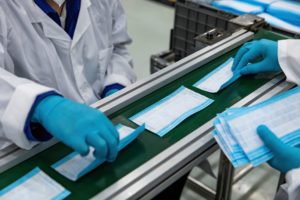
A project team including Henderson Sewing Machine Company, Yaskawa Motoman, HomTex Inc. and Siemens Corporation has banded together to address the shortage of PPE through robotics. The project, titled Rapid PPE Production through Automation & Robotics (RAPPAR), aims to speed up the production, testing, and packaging processes by utilizing robotics automatic visual inspection, picking-and-sorting, and end-of-line packing and palletizing of masks. This will help address the long lead times currently facing mask distribution in the U.S.
At the ARM Institute, we have even more exciting projects totaling $8 million to bring to fruition.
All of these are just a handful of examples of how robots are aiding us in fighting back the spread of the Coronavirus. Even post-COVID, these advances in robotics technology will continue to aid us in recovery and beyond. The story of robotics and COVID-19 is also a reminder that technical skills can help workers support public health, manufacturing, and emergency response needs.
What COVID-19 and Robotics Taught the Workforce
The pandemic helped people learn about the power of automation, with many businesses needing to rapidly implement automated solutions to meet demand.. Hospitals, labs, public buildings, and factories all had work that needed speed, steady accuracy, and less close contact where possible. Robots helped with some of that. They handled repeated tasks, supported cleaning, moved materials, and helped teams keep up when the workload got heavy.
That did not push people out of the picture. It put more attention on the people who knew how to work with the equipment. Someone had to plan the process. Someone had to program the machine, check the results, keep the system running, and fix problems when the day went sideways.
The link between robotics and COVID-19 also showed how many different jobs robotics can touch. One robot might support disinfection. Another might help prepare samples or inspect products. In manufacturing, automation can help with packaging, sorting, production flow, and other tasks that keep work moving.
For students, job seekers, and manufacturing workers, the lesson is pretty straightforward. Robotics skills can travel across industries. Training in robot operation, maintenance, programming, automation systems, or manufacturing technology can help workers move toward roles tied to real demand.
RoboticsCareer.org gives people a practical place to start, with job previews, training resources, and career tools focused on manufacturing robotics. Create a profile to get started today!

RoboticsCareer.org is powered by the ARM (Advanced Robotics for Manufacturing) Institute, a Manufacturing Innovation Institute part of the Manufacturing USA Network. RoboticsCareer.org was created through collaboration with the ARM Institute’s member organizations spanning industry, government, and academia. Funding was provided by the U.S. Department of War and a grant from the U.S. Department of Labor.
